
Packages arrive more punctually, warehouses sort proactively, supply chains react almost in real time: what sounds like the future is already everyday practice in many companies—and often the result of artificial intelligence. This is not entirely new. Automated systems have been supporting logistics processes for years. What has changed, however, is the quality of the technology: today, AI-powered tools analyze huge volumes of data, learn from patterns, and continuously adapt. This creates possibilities that go far beyond classic automation—from intelligent route planning to dynamic warehouse optimization. It’s time to take a closer look at what modern AI in logistics really delivers.
What is meant by AI in logistics?
Artificial intelligence (AI) describes systems that can perform tasks independently, make decisions, and learn from data—similar to a human, only faster and based on significantly larger amounts of information. In logistics, this means, for example: algorithms calculate optimal delivery routes, detect anomalies in inventory, or predict when and where a product will be needed.
It’s important to distinguish AI from classic automation. While automation executes fixed processes according to rigid rules, AI recognizes patterns, develops solutions independently, and reacts flexibly to new situations. This makes it a strategic tool for complex, data-driven processes.
Core subfields of AI that are particularly relevant in logistics include:
- Machine learning: Systems learn from historical data, e.g., on demand or capacity utilization, and continuously improve their forecasts.
- Image recognition: Camera systems identify damaged packages, read labels, or automatically inspect goods.
- Predictive analytics: AI detects trends, for example in demand patterns, and makes preventive decisions for inventory or transport.
Logistics is an ideal playing field for AI: high data availability, numerous process interfaces, and growing pressure to increase efficiency make it a sector with particularly strong potential.
Application areas of AI in logistics
In logistics, AI takes on concrete tasks and becomes a strategic tool. Whether in warehouse management, route optimization, or risk analysis in the supply chain: AI-based systems intervene where large volumes of data meet complex workflows. The following section shows how AI can measurably improve the most important logistics processes.
Demand forecasting & planning
Those who know what will be needed tomorrow can plan better today. That’s exactly what AI enables in demand planning: based on historical data, seasonal fluctuations, current trends, and external influences, intelligent systems forecast how demand will develop—and are often more precise than traditional planning methods.
These forecasts form the basis for dynamic inventory management. Instead of working with static minimum quantities, the system adjusts stock levels flexibly, for example during short-term demand peaks or disruptions in the supply chain. This reduces both overstock and shortages, which tie up capital and jeopardize delivery capability.
The result: fewer stockouts, less waste, greater predictability, and an optimized balance between storage costs and availability.
Route optimization & fleet management
Fewer detours, shorter delivery times, lower consumption—AI turns route planning into an intelligent process. Rigid route plans are replaced by modern software that uses up-to-date traffic data, weather information, and delivery priorities to calculate the most efficient route in real time. The system analyzes not only which route is the shortest but also which is the most reliable—taking into account, for example, roadworks, accidents, or delays in urban last-mile delivery. Short-term changes, such as outages or ad hoc orders, can also be factored in dynamically.
Additional benefits: more efficient routes also reduce fuel consumption and CO₂ emissions. This development benefits both the environment and the cost structure.
Warehouse automation & robotics
Gripping, sorting, packing—and all at impressive speed: intelligent robotic systems are increasingly taking over tasks in warehouse logistics that used to be the sole preserve of humans. The big difference: AI-controlled robots are fast and capable of learning. They recognize items, securely grasp objects of different shapes, and navigate the warehouse autonomously.
This technology becomes particularly effective when combined with image recognition. Camera systems analyze the condition of goods at goods-in or check the completeness of shipments at dispatch. Errors, damage, or missing items can thus be detected and corrected in real time.
The overview becomes even more precise when linked with IoT sensors. These measure, for example, temperature, vibration, or storage positions and supply the data that AI systems need to make even smarter decisions. The result: a warehouse that thinks, learns, and grows with you.
Quality assurance & damage prevention
Whether damaged packaging, excessive temperatures, or deviating dimensions: even the smallest irregularities can have major consequences in logistics. Artificial intelligence helps to detect precisely such deviations at an early stage. Using cameras, sensors, and learning algorithms, AI systems analyze the condition of goods in real time and trigger an alert as soon as something deviates from the target.
This precision is particularly important for sensitive products, for example in food or pharmaceutical logistics. Systems monitor temperatures, humidity, or vibrations along the entire supply chain. If AI detects an impending loss of quality, an automated early warning system intervenes and provides timely guidance before any damage occurs.
Document processing & communication
Logistics generates hundreds of documents every day: delivery notes, invoices, freight papers, or customs documents. Tasks that employees used to handle manually are increasingly taken over by AI today. It works faster, error-free, and around the clock. And because it relieves employees of repetitive tasks, they can focus on their core competencies or further optimize administrative workflows. Intelligent systems automatically read documents, capture relevant content, and link it to the appropriate processes in the ERP or warehouse management system.
AI also shows its strengths in communication: chatbots or virtual assistants answer customer inquiries about shipment status, delivery times, or complaints—without waiting times and even outside business hours. At the same time, AI supports internal communication, for example through automatic notifications about delays or missing information to involved service providers.
Benefits of AI in logistics—and what’s still missing
Artificial intelligence makes logistics processes not only faster but also smarter. More precise forecasts, automated workflows, and intelligent decisions deliver tangible efficiency gains. Inventory can be managed optimally, transport routes can be utilized better, and administrative tasks can be greatly accelerated. This saves time and reduces costs. At the same time, the error rate decreases. Systems detect inconsistencies early, prevent misdeliveries or bottlenecks, and thus contribute to process reliability. For customers, this means reliable delivery times, transparent communication, and an overall better service experience.
However, not every logistics challenge can be solved by an algorithm. Many companies face similar hurdles—especially with data quality. AI needs structured, complete, and connected information to realize its full potential. There are also data protection issues, particularly with sensitive customer data or in an international context.
The technical transition is also demanding: legacy systems must be integrated, interfaces created, and new solutions embedded into existing IT landscapes. This is accompanied by investments in infrastructure, training, and change management.
Between aspiration and reality—when AI (still) doesn’t fit
AI in logistics often sounds like the answer to every challenge. But not every warehouse is built for it. And not every process automatically benefits from neural networks and learning systems. In many cases, the effort, complexity, and costs exceed the actual benefits. This is especially true for small and medium-sized companies that store specialized products such as wood, metal, or building materials, which often don’t need self-learning algorithms but robust, reliable technology that works today.
Moreover, the use of AI presupposes high data quality, well-thought-out IT infrastructure, and deep integration into existing systems. In practice, this is not always feasible and can quickly lead to overambitious, costly projects that have little to do with day-to-day warehouse operations.
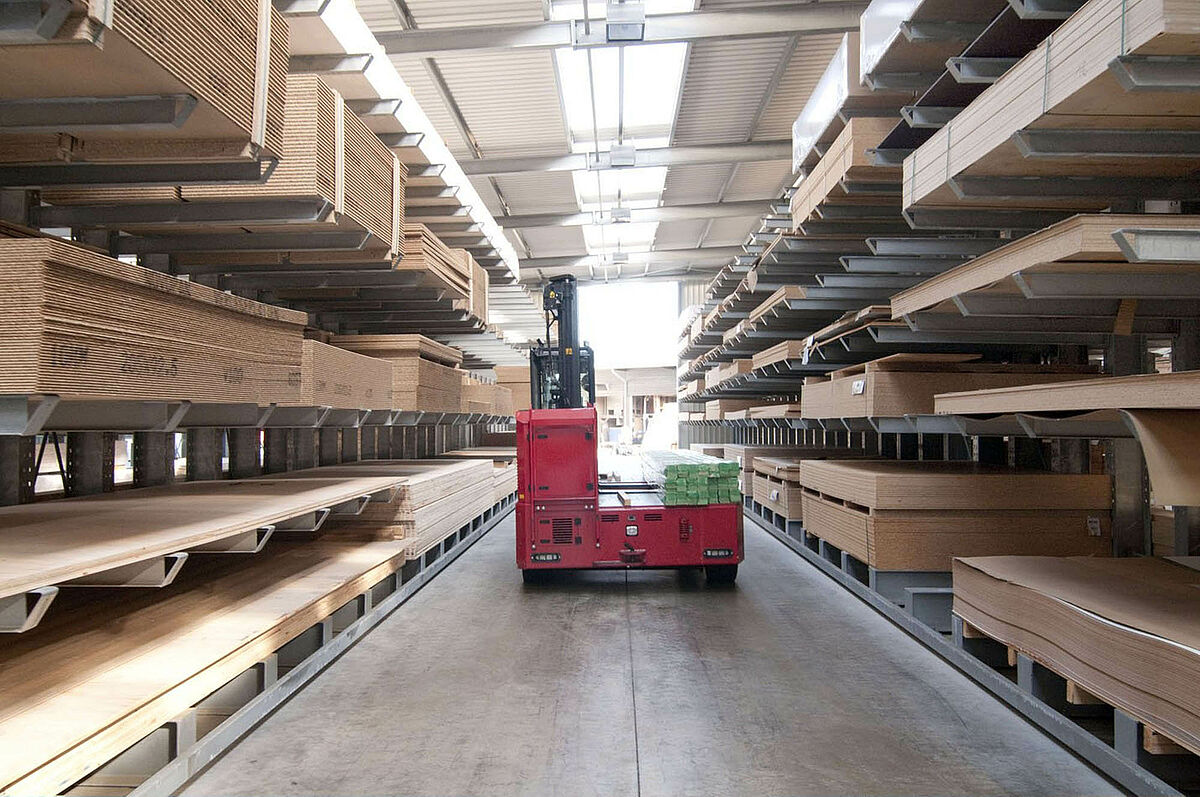
If you still want to automate processes and make them future-proof, you are often better served with automated storage systems. OHRA offers proven solutions that seamlessly connect racking systems, conveyor technology, and warehouse management software. These systems are particularly suitable for heavy, bulky, or long goods—for example from the wood, metal, or building materials industries—and deliver greater efficiency, safety, and warehouse transparency. Semi- or fully automated installations can be tailored precisely to operational requirements and usually pay for themselves faster than expected thanks to reduced error rates, higher throughput, and optimal space utilization.
Automate rather than overengineer—for many companies, this is the realistic path to a strong economic future.
Outlook—where is AI in logistics heading?
What is still a pilot project today could be standard tomorrow. In logistics, artificial intelligence is constantly opening up new perspectives—from autonomous transport solutions to fully integrated supply chains.
Autonomous delivery vehicles and drones are more than just a PR stunt. They enable contactless deliveries, ease pressure on scarce personnel resources, and respond flexibly to traffic or weather conditions. Initial applications in urban areas show: the technology works—now what’s needed are clear legal frameworks and scalable concepts for widespread deployment.
Changes are also happening inside warehouses. Self-learning systems analyze movement data, adjust warehouse structures dynamically, and continuously optimize put-away or picking—without human intervention. The combination of AI, robotics, and IoT creates a logistics system that not only reacts but anticipates.
And at the strategic level? More and more companies are using AI to transform their supply chain planning. Instead of planning in rigid cycles, they work with scenarios based on real-time data. Supply shortages, geopolitical risks, or demand shifts can thus be identified earlier—and balanced out more quickly.
In short: the role of AI in logistics is becoming larger, more connected, and more strategic. Those who position themselves well now will gain an advantage that goes far beyond operational efficiency.
Conclusion—progress doesn’t always mean high-tech
Artificial intelligence is changing logistics—no question. But not every innovation is automatically a step forward for every warehouse. Those who blindly bet on AI now risk a lot of effort without real added value. What’s needed instead: a clear understanding of your own processes, a sober evaluation of the potential—and solutions that truly fit.
Especially in industries with heavy, long, or sensitive goods, automated storage systems show how efficient digitalization can already be today—without artificial intelligence. Those who automate processes with a clear focus reduce errors, save space, and gain speed. And in doing so, they create a foundation ready for whatever tomorrow brings.
It’s not the most technology that decides success, but the best solution for the specific need. And this is often where the real competitive advantage lies.
Would you like to modernize your warehouse? We are always happy to assist you with strategic questions as well.
