
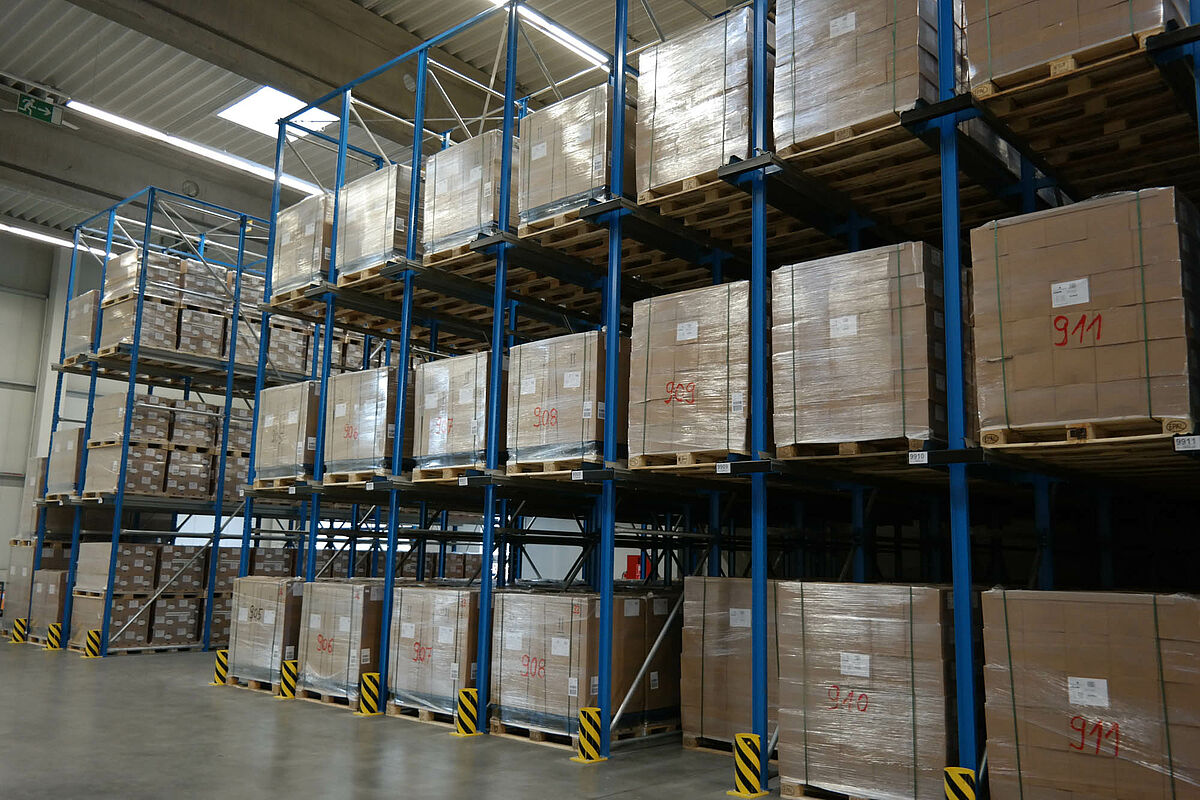
Imagine your products could be with the customer in no time—without high storage costs and with maximum efficiency. Sounds good, right? But which warehousing strategy makes it possible: a central warehouse that brings all the strings together in one place, or multiple decentralized warehouses that are closer to the customer? Choosing between centralized and decentralized warehousing is one of the most important decisions for companies—with direct impacts on costs, delivery times, and customer satisfaction. In this article, you’ll find out which strategy fits your business.
What do centralized and decentralized warehousing mean?
Centralized warehousing means that all products are managed and stored at a single location. Companies consolidate their inventory here to structure logistics efficiently and better control costs. A central warehouse offers advantages especially for industries with a large product range, such as metal trading: all metal products can be stored centrally, picked efficiently, and shipped cost-effectively. Centralized management ensures that inventory data is always up to date and bottlenecks are identified at an early stage.
In contrast, decentralized warehousing relies on multiple warehouse locations that are closer to customers or production sites. This strategy increases flexibility and shortens delivery times—a clear advantage for companies that need to respond quickly to orders. One example: a specialty retailer with several regional locations can use decentralized warehouses to ensure that frequently requested products, such as building materials or tools, are always quickly available. Proximity to the customer not only shortens transport routes but also increases customer satisfaction.
Advantages and disadvantages
Advantages of a central warehouse
- Efficient cost and inventory management
A central warehouse saves costs through standardized processes for goods receipt, picking, and shipping. Centralized management enables precise tracking of all goods movements and reduces overstock as well as tied-up capital. Wholesalers and particularly mechanical engineering and metalworking companies benefit from lower operating costs and optimized warehouse planning. - Central control and planning reliability
Thanks to centralized monitoring, companies always have their inventory in view and can detect bottlenecks early. Consolidated management also simplifies the planning of storage capacities and transport routes. - Reduced transport costs through consolidated deliveries
The ability to ship large consolidated orders reduces the number of trips and lowers transport costs per unit. This is particularly efficient for bulky goods such as wood panels or metal profiles. - High level of automation
Standardized processes in central warehouses make it easier to deploy picking robots, automated guided vehicles (AGVs), and stacker cranes. These automations reduce personnel costs, minimize errors, and enable efficient, real-time inventory management.
Particularly relevant for these industries: Mechanical engineering & metalworking, specialty retail, industry
Suitable racking systems: Automated storage systems, high-bay warehouses, mobile racking
Disadvantages of a central warehouse
- Longer delivery times
A central warehouse increases the distance to customers, resulting in longer delivery times—especially problematic for industries such as the timber and building materials trade that must respond quickly to orders. - Higher transport costs
Longer transport routes cause higher costs, particularly for bulky or heavy products such as metal profiles or wood panels. While larger shipments reduce the cost per unit, total costs rise the farther customers are located. - Increased risk of downtime
If the central warehouse goes down due to technical issues, the entire supply chain comes to a standstill. Decentralized warehouses offer greater resilience through better risk distribution. - Less flexibility with demand changes
Central warehouses are less adaptable to short-term demand fluctuations. In the case of sudden orders or seasonal peaks, they quickly reach capacity limits. - High investment costs
Building a central warehouse requires significant investments in logistics systems, technology, and personnel. For smaller companies, this barrier to entry is often too high. - Higher safety stocks
Larger safety stocks are necessary to avoid supply bottlenecks, which increases tied-up capital and storage costs.
Specific challenges for e-commerce
Central warehouses are widespread in e-commerce to manage large product volumes efficiently. However, they also bring challenges: customers expect ever shorter delivery times, often same-day. At the same time, the high return rate in online retail leads to increased effort for returns handling and restocking. To meet these demands, many e-commerce companies rely on a combination of central and decentralized warehouses or outsource returns logistics to specialized service providers.
Advantages of a decentralized warehouse
- Shorter delivery times
Decentralized warehouses are closer to customers or production sites, significantly shortening delivery times. The building materials trade and regional specialty retailers particularly benefit from fast deliveries that boost customer satisfaction. - Lower transport costs
Regional warehouses reduce transport distances and thus costs. Products no longer have to be shipped across the country, which is not only cheaper but also reduces environmental impact. This is especially true for industries such as the aluminum and plastics trade as well as vehicle recyclers. - Greater flexibility
With multiple locations, companies can respond faster to regional demand fluctuations. Spare parts logistics and metal trading benefit from having required products available without delay. - Risk mitigation through multiple sites
If disruptions occur at one site, another warehouse can step in. This risk diversification ensures stable supply chains—especially important for industry and metalworking. - Leveraging regional market knowledge
Decentralized warehouses make it possible to tailor assortments more closely to regional needs. Specialty retailers can focus specifically on seasonal items and regional bestsellers. - Efficient inventory management
Distributing inventory across multiple locations offers flexibility in stockholding. However, safety stocks must be well coordinated to avoid overstock.
Particularly relevant for these industries: Building materials, aluminum / plastics, metal trading, specialty retail, vehicle recyclers & towing services, timber trade and wood processors
Suitable racking systems: Cantilever racks for long goods and heavy loads, pallet racks, mobile racking, automated storage systems
Disadvantages of a decentralized warehouse
- Higher operating costs:
Multiple locations incur higher fixed costs for rent, personnel, and administration. Smaller specialty retailers and companies in the timber trade face financial challenges. Investments in logistics systems are also required to coordinate processes efficiently. - Complex inventory management and misallocation risks:
Decentralized warehouses increase the risk of overstock at one location and shortages at another. Misallocations—such as products at the wrong site—lead to longer delivery times and higher transport costs. To prevent this, powerful warehouse management systems (WMS) are necessary to track stock movements in real time and automate transfers. - High coordination effort:
Coordination between multiple locations is time-consuming and requires robust IT systems. Without centralized control, uncertainties and delays can quickly arise—for example, when synchronizing orders or planning delivery routes. - Efficiency loss due to stock dispersion:
Distributing inventory across several warehouses often leads to inefficient use of storage space. While some products gather dust, others face space shortages. The building materials and metal trading sectors are particularly affected. - High requirements for IT and logistics systems:
Decentralized warehouses need complex IT infrastructures to ensure communication between locations. Integrating WMS and ERP systems is costly but essential to avoid incorrect bookings and duplicate orders.
Hybrid warehousing strategies—best of both worlds?
Hybrid warehousing strategies combine central and decentralized warehouses to leverage the advantages of both approaches. While central warehouses score with efficient inventory management and lower operating costs, decentralized warehouses offer short delivery times and high flexibility. Companies therefore increasingly rely on a mix of both concepts: the central warehouse serves as the main location for the complete range and higher-level inventory management. Decentralized warehouses, on the other hand, handle rapid supply of frequently requested items in specific regions.
This strategy is particularly suitable for specialty retailers and wholesalers that offer a broad product range but also depend on fast deliveries. For example, a central warehouse could manage the entire range of metal goods or components, while regional warehouses provide frequently ordered screws, profiles, or fittings directly on site. Companies with seasonal products also benefit: while the central warehouse ensures steady supply, seasonal highlights can be quickly ramped up in decentralized warehouses.
Practical examples of hybrid warehousing strategies
A company in the building materials trade could centrally store rarely requested specialty products to reduce costs. At the same time, decentralized warehouses would ensure fast deliveries of frequently needed items such as cement, wood panels, or screws.
In metalworking, companies also rely on hybrid concepts: a central warehouse manages standard products such as steel profiles, while decentralized warehouses keep specific components available for regional production sites.
Implementing hybrid warehousing strategies requires sophisticated logistics planning and powerful IT systems. Only then can inventory be managed efficiently and transport routes optimized. When done well, companies benefit from increased delivery capability while reducing storage and transport costs.
Outsourcing to logistics service providers
Outsourcing warehouse logistics to specialized service providers is becoming increasingly important. Companies not only save operating costs but also benefit from the expertise and technological solutions of logistics providers. Small and medium-sized enterprises in particular can save storage space, personnel, and expensive investments in warehouse systems through outsourcing.
Logistics providers handle the entire process—from storage to picking to shipping. This allows companies to focus on their core business without sacrificing efficient warehouse processes. Another advantage is flexibility: service providers can quickly adapt storage capacity to changing needs and cover seasonal peaks without additional investments.
Example: A metal trader could outsource central inventory to an external logistics provider to save transport costs while benefiting from automated storage systems and just-in-time deliveries. The building materials trade can also achieve shorter delivery times and lower costs by working with regional logistics partners.
Advantages of outsourcing:
- Cost savings: No investments in own warehouse infrastructure or personnel.
- Greater flexibility: Faster adaptation to fluctuating needs and seasonal peaks.
- Technological advantages: Access to modern storage systems and automated processes.
- Risk minimization: Logistics providers take on liability and risk management for inventory.
Disadvantages of outsourcing:
- Dependence: Companies relinquish control over critical warehouse processes.
- Data security: Sharing sensitive inventory and customer data requires clear contracts and high security standards.
- Costs for complex products: Special requirements, such as for hazardous goods or temperature-controlled storage, can lead to high outsourcing costs.
Location selection as a strategic decision
Choosing warehouse locations is one of the most important strategic decisions in logistics. It influences not only delivery times and transport costs but also customer satisfaction and the flexibility of the entire supply chain. Companies must weigh numerous factors: proximity to customers and suppliers, regional infrastructure, land costs, and regulatory conditions.
A central location makes it possible to consolidate deliveries efficiently and reduce transport costs—especially when the customer base is widely dispersed. Decentralized warehouses, on the other hand, offer advantages when regional demand differs, as they enable faster delivery times and greater flexibility.
Example: A company in metalworking could benefit from a central warehouse to distribute standardized products efficiently throughout Germany. A building materials dealer, however, would be better served with several decentralized warehouses to supply regional construction sites without delay.
Key criteria for location selection:
- Customer proximity: Sites should be chosen to enable fast delivery times.
- Transport infrastructure: Good connections to highways, ports, or airports simplify logistics.
- Costs: Land and operating costs vary greatly by region.
- Flexibility: The potential to expand storage space should be considered during site selection.
The right location strategy can be crucial in reducing storage costs and boosting delivery performance. Detailed analysis and planning are therefore essential to remain competitive in the long term.
Centralized or decentralized warehouse—which strategy suits your company?
The choice between a central or decentralized warehouse depends heavily on your company’s specific requirements. A centralized structure is particularly suitable for companies with a broad range and a nationwide target group. Mechanical engineering firms or metal traders benefit especially, as central warehouses not only simplify inventory management but also reduce operating costs. Consolidating transport also saves time and money—ideal for companies with complex supply chains.
Decentralized warehouses, on the other hand, come into their own when short delivery times and high flexibility are required. Building materials dealers or specialty retailers operating regionally rely on several smaller warehouses closer to customers. This better absorbs seasonal fluctuations and keeps transport routes to end customers short. Companies with a high number of returns or spare parts also prefer decentralized solutions to process returns more efficiently.
The size of the product range also plays an important role: a central warehouse is particularly suitable when many different products need to be managed efficiently. Decentralized warehouses perform better with fewer but frequently requested items. Storage costs should not be underestimated either: while central warehouses offer cost advantages through a unified structure, decentralized warehouses incur higher expenses for personnel and administration.
The decision for one of the two strategies should therefore be carefully considered. Companies that need both a broad product range and fast delivery times often benefit from hybrid warehousing strategies that combine the advantages of both approaches.
Conclusion—centralized vs. decentralized warehousing
The choice between centralized and decentralized warehousing depends strongly on a company’s individual requirements. Central warehouses convince with efficiency, simplified inventory management, and lower operating costs. They are particularly suitable for companies with a wide product range and a nationwide target group. Decentralized warehouses, on the other hand, score with short delivery times, higher flexibility, and better outage protection. They are ideal for companies that focus heavily on regional markets or need to balance seasonal fluctuations.
For many companies, however, a hybrid warehousing strategy could be the optimal solution. By combining central and decentralized warehouses, the advantages of both approaches can be utilized without fully accepting their respective disadvantages. A central warehouse for the main assortment and decentralized warehouses for frequently requested items deliver both efficiency and flexibility.
The decision on the right warehousing strategy should therefore be based on a precise analysis of storage costs, delivery times, and target group requirements. Comprehensive consulting by logistics experts can provide valuable support in finding the ideal solution.
Consulting on warehouse solutions—which system suits you?
Not sure which warehousing strategy is best for your company? Contact us for a no-obligation consultation! Our experts analyze your requirements and show you whether a central, decentralized, or hybrid warehouse concept makes the most sense. In doing so, we consider not only your storage costs and delivery times but also the specific requirements of your industry and products.
Whether you want to optimize your warehouse logistics or implement a completely new warehousing system—we support you from planning through to implementation. Schedule an appointment now and find out which warehousing system is perfect for you!
