
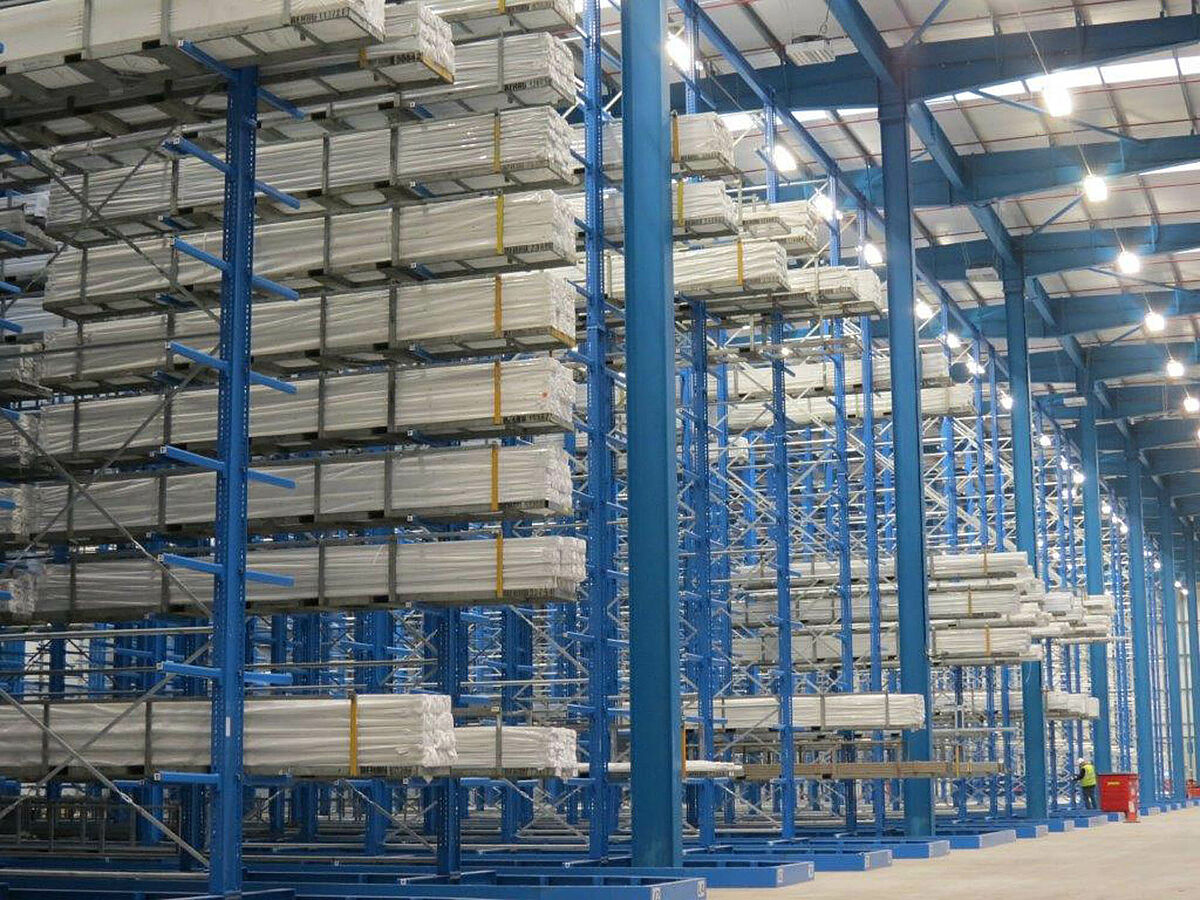
Imagine two warehouses, both the same size. Same floor area, same height, same investment. And yet everything runs smoothly in one, while time is lost daily in the other: pallets are in the way, long profiles are awkward to turn, traffic routes cross, and unused square meters mutate into storage areas.
But the difference doesn't arise from the facade. It arises from the question of what happens inside the hall and what needs to go into it. Anyone planning a warehouse construction or having a hall built should not start with the building, but with the usage: stored goods, turnover, handling and protection requirements. Because if racking systems, loads, and material flow are only considered retrospectively, adjustments quickly turn into costly conversions.
This article takes a shortcut through the complexity of warehouse construction. We look at typical industries and stored goods and derive from them which requirements arise for the hall – and which storage technology fits.
Planning warehouse construction: Requirements must be clear
Before you compare quotes or go into draft planning with a hall builder, it is worth taking a step back: What exactly should the hall achieve in everyday life? Defining the usage profile cleanly saves discussions later about “actually we still need…” and avoids expensive rework on the floor, gates, traffic routes, or storage technology.
1) Stored goods: What are you storing – and in what form?
Whether long goods, palletized goods, sheets, bulk material, or a mixed warehouse: The stored goods determine load capacities, racking systems, aisle widths, and handling equipment. Profiles and beams require different access areas than palletized cartons. Sheet material places different demands on protection and removal than bulk material in big bags.
2) Turnover: Buffer storage or daily movement?
Do you mainly store in and out, or is there order picking? are there strong peaks, seasonal goods or project-related storage? And is Cross-Docking an issue – i.e., goods that only pass through briefly and are not “properly” stored? Depending on the turnover, the layout, the zones (goods receipt, staging, shipping), and the sensible placement of gates and traffic routes change.
3) Inventory strategy: How should goods flow?
In warehouse construction, too, the question of which principle you use for storage and retrieval is important: FIFO (First In – First Out) is often sensible for goods relevant to aging or batches. LIFO (Last In – First Out) can fit certain stacking or block storage concepts. Equally crucial is the choice between static or dynamic storage. This influences not only processes but also the type of storage technology and the required transparency in the warehouse.
4) Security and protection needs: What must the hall achieve?
Must the stored goods be kept dry, temperature-controlled, or specially secured? How high is the fire load, how sensitive are surfaces, how relevant is theft protection? These points have a direct effect on the hall envelope, insulation, gate concept, lighting – and on the question of whether areas need to be separated.
Rule of thumb for warehouse construction: First usage profile, then hall shape.
Industry requirements in warehouse construction: Avoiding typical stumbling blocks
When building a warehouse, there is no “one-size-fits-all” solution. Two companies may need the same square footage and yet have completely different requirements. The reason is usually not the inventory itself, but the handling: length, weight, surface, turnover, and access frequency. Knowing industry-typical stumbling blocks early allows them to be solved directly in hall planning and storage technology.
Timber trade/Processed wood and furniture/Timber construction and carpentry
Typical stumbling blocks in the Timber trade: Overlengths and bundled goods need space – not just in the rack, but also when maneuvering. In planning, gates often turn out too small or are inconveniently located for the material flow. Later, it turns out that long goods can be stored, but not moved efficiently. Sheet material is a second issue: In planning, it seems secondary, but in practice, it quickly becomes bulky and susceptible to damage or moisture.
What matters:
- Derive hall length/height consistently from the lengths of the goods and the rack height
- Plan gates, traffic routes, and maneuvering areas so that sideloaders or long load units can turn safely
- Consider weather protection and moisture management (especially in partially open areas)
Suitable approaches:
For long goods, Cantilever racking or Cantilever rack for long goods are obvious choices; for outdoor storage or weather-sensitive goods, a Cantilever racking with roof is suitable. For sheet material, Vertical racking systems are often the cleanest solution because removal and moisture protection are easier to plan.
Metal trade / Engineering and metal processors
In the Metal trade, goods are rarely “just heavy”. They are often point-load intensive. Coils, profiles, steel bars, or tool carriers load the floor and racks differently than classic palletized goods. A common mistake in warehouse construction: Statics and floor slabs are not consistently designed for real load cases. A second classic is the lack of protection against collision damage: Especially with crane operation or tight traffic, this quickly becomes a safety and cost problem.
What matters:
- Define load assumptions (rack and floor loads) early and secure them statically
- Clearly define crane areas, safety distances, and traffic routes
- Integrate collision/ram protection and safety concepts directly into the layout
Suitable approaches:
For high loads, Heavy-duty cantilever racking is suitable; for palletized components or accessories, Pallet racking makes sense. If space is scarce, Mobile racking can enable additional compaction – provided the material flow fits.
Building materials
Building materials warehouses are often complex as they are operated as mixed storage: palletized goods, bulky individual items, weather-sensitive materials – all side by side. If hall zones are not planned cleanly, unnecessary paths, search times, and “storage islands” arise. Furthermore, it is underestimated that order picking needs access, not just storage spaces.
What matters:
- Outdoor/Indoor concept: What really needs to go inside, what can stay outside under a roof?
- Fast order picking through clear paths and sensible zones
- Structure the assortment so that the hall does not become a compromise for everything
Suitable approaches:
For bulky lengths and profiles: Cantilever racking with roof. For classic pallet positions: Pallet racking. And if a covered, robust solution between outdoor storage and the hall is required, a Rack Clad buildings solution can fit.
Alu-plastic (Profiles, sheets, sensitive surfaces)
In the Alu-plastic industry, in warehouse construction, it is less about maximum load capacity, but often about quality: scratches, pressure marks, warping, or contamination. Anyone who does not separate storage zones cleanly or plans handling paths too narrowly produces scrap. And: Sheets and long profiles behave differently than compact pallets – deflection and improper support are real issues.
What matters:
- Clean, protected storage zones (possibly insulated areas, depending on the product)
- Plan handling so that surfaces do not come into unnecessary contact
- Choose storage technology that supports sheets/profiles stably and makes them removable
Suitable approaches:
Vertical racking systems for sheet storage and a Cantilever rack for long goods for profiles are often the right combination here.
Hall planning in warehouse construction
In warehouse construction, efficiency is often decided not by the floor area, but by the centimeters above and between. A hall can seem spacious and yet waste storage spaces – or unnecessarily lengthen paths. To ensure hall geometry and racking systems really fit together, it is worth looking at three adjusting screws: height, movement areas, and service.
1) Hall height vs. racking height: The height must be usable
Many companies plan the hall height according to “standard values”. The problem: racking height, safety distances, and building services come later and eat up the leeway. For warehouse construction, this means:
- Racking height (e.g., Pallet racking or Cantilever racking) is only part of the calculation.
- Added to this are safety distances, lighting, beams/girders and – depending on the concept – sprinkler pipes.
- If these components are inconveniently located, “8 meters height” can quickly become “6.50 meters usable”. In practice, this often means several racking levels less.
2) Aisle widths & industrial trucks: Creating space where movement happens
Aisles are not “residual space” when building a warehouse, but workspace. Crucial is which industrial trucks really drive: front loaders, reach trucks, sideloaders, order pickers – every system needs different maneuvering and safety spaces. Aisles that are too narrow slow things down, aisles that are too wide waste space. The art lies in coordination: rack type, vehicle, throughput, and safety concept must be thought of together.
3) Gates & Service:
Material flow beats symmetry. In hall planning in warehouse construction, a symmetrical solution often looks “nice” but is not automatically efficient. Gates, ramps, and service zones should be located where the material flow needs them:
- short path from goods receipt to buffer/replenishment
- clear separation of goods receipt, order picking, and shipping
- sufficient pre-zone for unloading, repacking, checking, and staging. Anyone who does not plan these zones in the floor plan will organize them “somewhere” later – and pay daily with longer paths.
If you would like to delve deeper into the subject, we recommend our blog post on optimizing warehouse processes.
Hall construction and racking system
There is no blanket solution in warehouse construction. A conventional steel hall is ideal if you need versatile usage options. But especially with heavy loads, long goods, or building materials, the combination of “standard hall plus heavy-duty rack” often leads to unnecessary costs and loss of space due to double support structures.
An efficient alternative for high loads is often the so-called Rack Clad buildings solution. Here, the racking system itself acts as the supporting structure. Roof and walls are attached directly to the rack uprights.
The plus points of this method:
- Fewer interfaces: Since the rack and envelope form a unit, complex coordination between the hall builder and rack supplier is eliminated. The verifiable statics can be created directly for the entire structure.
- Combined load-bearing capacity: The steel profiles fulfill two tasks simultaneously. They reliably bear the heavy storage loads and serve at the same time as a stable substructure for the roof and wall.
- Faster implementation: Since the assembly of the rack structure and building envelope takes place in one step, this streamlines the entire project flow and often noticeably reduces construction time.
Safety in warehouse construction
Safety in the warehouse looks like a mandatory program at first glance. In practice, it is a productivity factor: A well-thought-out safety concept prevents accidents, reduces downtime, and protects stored goods, racks, and building services from expensive damage.
Crucial is collision protection where maneuvering takes place daily – on rack and hall columns, in gate areas, and at crossings. Instead of retrofitting later, traffic routes, transitions, and protection points should be planned directly in the layout. Load signs and clear marking of aisles, storage spaces, and restricted areas create orientation, prevent incorrect loading, and keep escape routes free in everyday life.
Since racks are constantly loaded, regular rack inspection belongs to the fixed process (responsibilities, intervals, documentation). In partially open halls or roofed areas, corrosion protection and robust surfaces are also particularly important.
Conclusion
Warehouse construction is successful when hall and storage technology are thought of together from the start. Anyone who builds first and then “looks for suitable racks” often wastes height, area, and process speed – and pays later with conversions.
If you want to avoid a hall becoming a compromise in warehouse construction, early coordination of stored goods, processes, racking system, and hall geometry is worthwhile. Talk to us: We support you with industry and needs analysis – and plan racking systems so that they fit your hall (and your everyday life).
