
Construction timber appears robust but reacts immediately to poor storage conditions. If goods stand on damp ground, they absorb water. If packages lie unevenly, the wood warps. And if edges are hit during maneuvering, quality drops – often exactly where dimensional accuracy counts later. The result is visible not only in the material but also in the processes: more rework, more waste, more complaints.
You don't just store construction timber; you prepare it for its use. A well-thought-out layout and appropriate storage technology are the guarantors for later success. Where do you unload? How do you separate qualities and lengths? Which paths do forklifts and sideloaders take, and how quickly do you get to the goods? In this article, we show how the storage of construction timber works cleanly in the operation, from goods receipt to the appropriate storage solution.
Storing construction timber correctly: The critical success factors
Anyone wanting to store construction timber should first clarify what material they are dealing with and what it will be used for later. Because not every construction timber "forgives" the same conditions. In the Timber trade, in Timber construction and carpentry the rule is: The higher the requirement for dimensional accuracy and surface, the more consistent the storage of construction timber must be.
Assortment
Even within the assortment, there are big differences. Structural timber, slats, squared timber, or formwork timber, often used in robust applications, still warp quickly if they lie poorly or absorb moisture. Solid structural timber and glued laminated timber are mostly used where millimeter-precise fits in joinery and warp-free visible components matter. The wood reacts accordingly sensitively to incorrect storage.
Moisture
The most important lever remains wood moisture. Wood absorbs water and releases it until it has adapted to the environment – this is called equilibrium moisture content. If moisture rises, the wood swells. If it drops, it shrinks. If the material is ventilated unevenly or becomes damp on one side, the wood deforms. If the construction timber stays damp for too long and gets too little air, the mold risk also increases significantly.
Location choice: What suits your construction timber?
A well-thought-out storage concept supports your daily work. Instead of just putting the wood somewhere, position it strategically according to its later purpose. This prevents damaged goods and keeps paths short for your forklifts.
Indoor storage
In indoor storage, you keep the best control over conditions. You store dry, clean, and predictably. At the same time, you significantly reduce the risk of moisture damage. The catch: Indoor space is expensive. This solution is therefore particularly worthwhile for wood that must remain dimensionally stable and whose surface must remain flawless.
Roofed storage
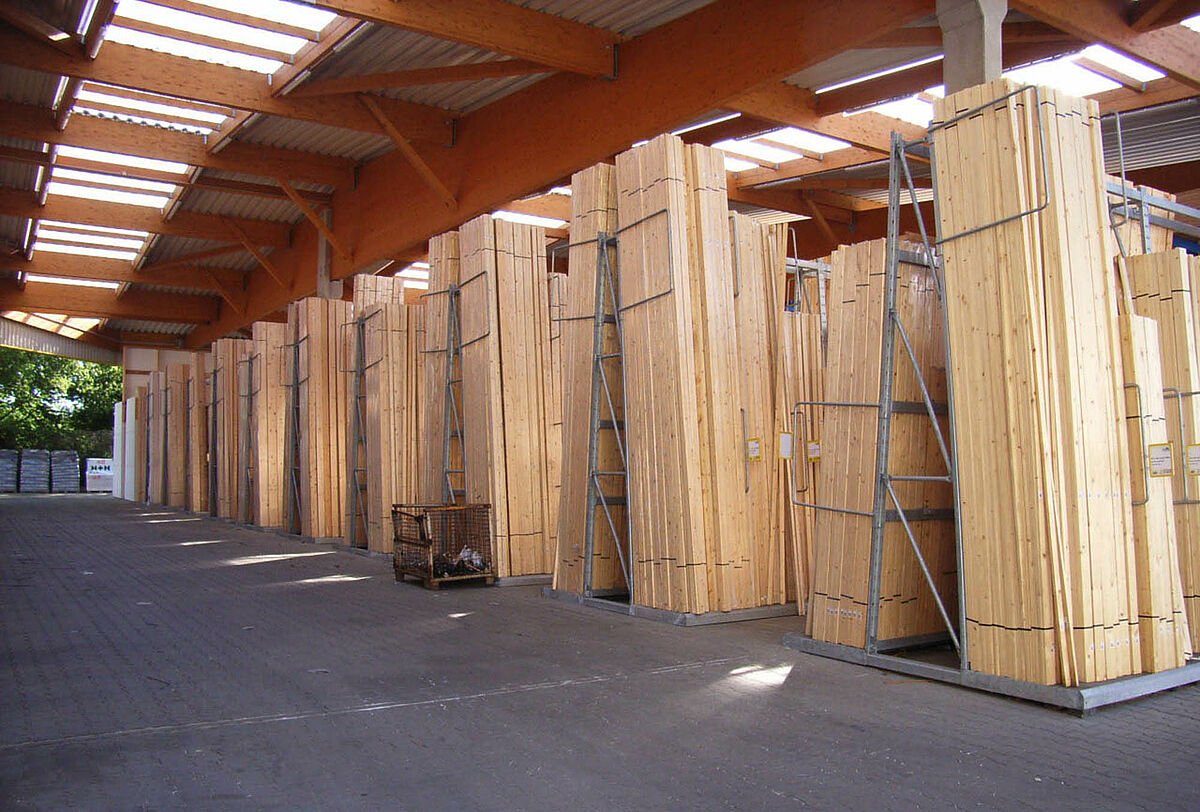
Roofed storage fits many wood assortments as a pragmatic middle ground. You keep rain and direct weathering away from the wood but simultaneously let air get to the wood. Especially in Specialist stores for timber, the advantage is evident: If you store long goods in stable racks instead of stacking them laboriously on the ground, you save valuable time during loading.
You lay long slats or profiles cleanly and keep the aisles free so that customers or employees can access them directly. Many companies in the Timber trade, Timber construction and carpentry use exactly this variant because it protects the wood and saves costs at the same time.
Outdoor storage
An outdoor storage area can also work – but only if you remain consistent. An optimal storage place fulfills these requirements:
- The ground is load-bearing and absolutely level.
- The stacks lie high enough above the ground.
- The water can drain off unhindered at any time.
- The cover shields against rain but still lets the wood breathe.
If you are negligent here, you quickly pay with damaged wood. Outdoor storage often saves hall space but demands clean standards in the storage of construction timber.
Storage organization for construction timber
The more neatly you store construction timber, the more time you save in everyday life. At the same time, you prevent employees from mixing different woods or accidentally loading the wrong batch.
Tip: Define storage slots so that your team places goods correctly without thinking much about it: first by product group, then by length, then by quality/batch. Signpost areas, rack bays, and aisles clearly visibly and keep the place "visually clean".
Use the FIFO principle primarily for standard goods to keep your stock healthy. This ensures that no package stands unnecessarily long and blocks space. For access, the following also applies: Fast movers within reach, slow movers higher up or further away. With an ABC analysis you set clear priorities instead of sorting by gut feeling. This keeps your construction timber storage clear – even when the area is full.
Choosing storage technology: Which racking systems prove themselves for construction timber
When you store construction timber, you can save a lot with good stacking techniques – but not everything. As soon as you handle larger quantities or manage many different assortments in parallel, simple solutions reach their limits. Now the right system decides whether your processes mesh smoothly or whether you lose valuable time daily.
Floor storage
Floor storage can work if you store few varieties, handle them rarely, and have enough space available. In practice, this tips quickly: You restack, search for packages, drive detours, and bump into things more often. Additionally, damages drive costs up: The wood gets dents, edges break off, or the material warps because it lies unevenly or draws moisture from the ground. Then "parking cheaply" suddenly becomes expensive – because the processes eat up time and you have to discard too much wood.
Cantilever racking
As soon as you want to store lengths, bundled goods, or squared timber safely and clearly, there are hardly any ways around Cantilever racking. The system ensures that your wood lies safely, you reach goods faster, and can keep aisles free. This saves maneuvering and reduces damage – especially when you pick frequently or manage several length classes in parallel. If you want to dive deeper, read our article on cantilever racking.
For typical long goods applications, a Cantilever rack for long goods is also suitable. This way you store bars, slats, squared timber, and formwork timber in a structured manner and ready to hand.
Single-sided or double-sided cantilever arms
The decision for single-sided or double-sided racking systems depends primarily on how you route traffic in the warehouse. If you place racks against a wall or at the edge of the hall, a Single Sided Cantilever racking often fits. This way you utilize your edge areas fully and keep the central aisles free.
If you plan a central row and want to access from both sides, a Double-sided cantilever rack is worthwhile. This brings a lot of storage space per meter of rack, but requires that your aisle widths and forklift paths match. Here a clean layout pays off – otherwise, you gain parking spaces but lose speed.
Cantilever racking with roof
As soon as you store construction timber outside or want to keep hall capacity free, simple solutions quickly reach their limits. Cantilever racking with roof protects the goods from direct weathering and keeps the storage places structured nevertheless. This protects your construction timber effectively against wetness. Furthermore, you save the high effort of covering the material repeatedly should the weather change.
Vertical racking systems
If you store board material, cuts, or remnants alongside construction timber, you should differentiate: While whole packages often lie in the cantilever rack, Vertical racking systems play out their strength directly at the workplace. Here employees can store individual boards standing upright, pull them out easily thanks to rollers, cut them, and store remnants again. This prevents boards from scratching in the stack and saves time since no forklift is needed for removing a single board.
Rack Clad buildings
If a large part of your stock lies outside or you need more covered space at short notice, Rack Clad buildings can be useful. You combine weather protection with a clear storage structure – without having to plan a complete building shell. Especially for timber and Building materials assortments, this often brings a noticeable step forward: Instead of erecting an expensive hall around the wood, you use the racks as a framework for the roof and thus keep your construction timber permanently dry.
Storing construction timber without damage
In the storage of construction timber, goods receipt sets the course. Check the delivery directly upon unloading for damage, pressure marks, and damp packaging. Record abnormalities briefly (photo) and document batch, dimensions, and quality before packages mix in the warehouse. Additionally, measure wood moisture randomly, especially after rain. Open damp packaging so that air gets to the wood without exposing it unprotected to the weather, and separate batches/qualities consistently in fixed zones. More on this in the article on efficient warehouse processes.
Support
Often not the hall, but the support determines the correct storage. Many damages occur because packages are placed "just briefly" – and then lie there longer. Never lay construction timber directly on concrete or asphalt, but always on support timbers. This allows the wood to get air from below. Set the support points in a line – front, middle, rear. If you offset support timbers, the package twists and the wood bends with it.
Stacking
Ensure an even surface. Even small unevenness presses through into the package over weeks. Plan fixed storage places instead of improvising every time. Only stack as high as everything stands stably. Ensure that the packages cannot tip, especially when storing narrow or long parts. Separating layers help when you have to separate qualities or lengths or when you want to bring air between the layers.
Covering
Effective protection arises when water drains off and the air circulates nevertheless. Instead of wrapping the wood airtight, ventilation gaps ensure that no wetness forms or mold sets in. The sides remain as open as possible but still protect against direct driving rain. With foils, good tension prevents water from remaining in depressions. A firm fixation additionally protects the cover from fluttering in the wind or chafing on sharp corners.
Safety & Operation in construction timber storage
Long goods often force forklifts and sideloaders into large maneuvers – and exactly there risks in the warehouse increase. Therefore, plan sufficient maneuvering areas, keep intersections open and avoid temporary storage in driveways. If people regularly walk through the warehouse, separate pedestrian and driving paths as best as possible.
Secure the sensitive points: Rack and hall uprights, gates, transitions, and intersections. Special protection profiles on the uprights ensure that small bumps do not have expensive consequences. Clear signs and markings help your team to arrange every package immediately in the right place and load the racks exactly fittingly. Finally comes the routine: Inspect racks regularly and document damages. This keeps your system safe.
Conclusion
Storing construction timber works best when you don't optimize at individual points but manage the warehouse as a system: Goods receipt, storage location, stacking, weather protection, technology, and labeling mesh with each other. All these measures keep the wood dimensionally stable, accelerate order picking, and ensure economic handling.
If you are currently rebuilding, expanding your timber storage, or simply want to bring more structure to your area, we are happy to support you. We analyze your processes and coordinate the layout and the racks exactly to your forklifts and driveways. This way we ensure that you utilize the space fully and store your construction timber efficiently. Contact us now. Together we optimize your operation.
